Breast fat transfer can last for many years, and in some cases, the results may be permanent. This is because the transferred fat that successfully integrates becomes a living part of your breast tissue.
At St. Louis Cosmetic Surgery, many women choose fat transfer breast augmentation versus implants to avoid future maintenance or foreign materials. However, it’s understandable to wonder how long fat transfer lasts in breasts compared to more traditional options.
Let’s take a closer look at how we approach each breast fat transfer, using precise techniques to support fat survival and create subtle, natural-looking results that stand the test of time.
WARNING:
This feature contains nudity. Please click OK to confirm you are at least 18 years of age and are not offended by such material.

Are Fat Transfer Breast Augmentation Results Permanent?
Fat transfer breast augmentation results are potentially permanent, with surviving fat remaining in the breasts indefinitely.
Once the transferred fat establishes a blood supply, it behaves like the rest of your natural tissue. This means your results should last permanently, although they may fluctuate with changes in your weight. Keeping a stable, healthy weight helps preserve your results.
How Soon Do You See Breast Fat Transfer Results?
Most of the changes you’ll see happen early. Within about 3 months, your body reabsorbs a portion of the fat, and the remaining volume stabilizes into your final result. If additional volume is desired, a second round of fat transfer can often be performed, provided there is enough donor fat available. If not, I’ll help you explore other innovative options for subtle breast enhancement.
“My goal is always to create results that look and feel natural. With fat transfer or alloClae,
we can enhance your shape in a safe, natural way that truly fits your body.”
Dr. Deniz Sarhaddi
What Is the Fat Survival Rate After Transfer to the Breast?
The fat survival rate after transfer to the breast is typically around 50% to 70%. This range reflects how much of the transferred fat successfully establishes circulation and becomes permanent. The rest is naturally broken down and absorbed by the body during the healing process.
As a board-certified plastic surgeon with extensive experience in breast fat grafting, I use refined harvesting and injection techniques to protect the fat cells and evenly distribute them throughout the breast. A precise approach is integral to maximizing cell survival and creating smooth, natural contours.
What Factors Affect Fat Transfer Breast Augmentation Longevity?
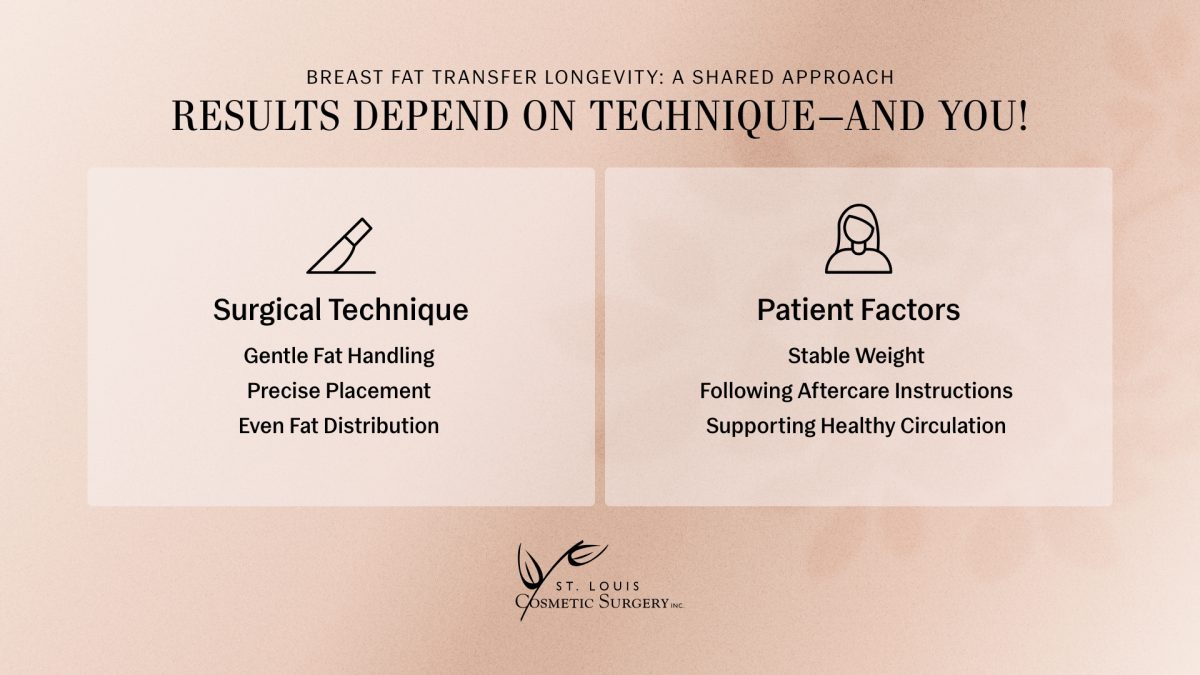
The longevity of fat transfer breast augmentation depends on surgical technique and individual factors related to your anatomy, healing response, and overall health.
From a surgical standpoint, long-term success hinges on:
- Gentle, careful handling of the fat during harvesting
- Precise placement into well-vascularized tissue
- Even distribution of fat to support healthy integration
From a patient perspective, longevity is influenced by:
- Maintaining a stable weight
- Following post-procedure care instructions
- Avoiding pressure on the breasts during early healing
- Supporting overall circulation and health
When these elements align, women tend to experience more predictable, long-lasting results.
Fat Transfer vs. Breast Implant Longevity: Is There a Difference?
Fat transfer provides long-lasting, potentially permanent results while avoiding foreign materials, while breast implants are durable but not lifetime devices and may require future replacement or revision.
With fat transfer:
- Results feel and look natural.
- There is no implant to maintain or replace.
- Volume can change with weight fluctuations.
With implants:
- You can achieve more dramatic size increases.
- Results are more immediately predictable in volume.
- Maintenance or revision may be needed over time.
If you’re just beginning to explore your options, you may find it helpful to review the various types of cosmetic breast surgery women consider at St. Louis Cosmetic Surgery.
Can You Combine Breast Implants With Fat Transfer?
I often recommend combining breast implants with fat transfer to achieve aesthetic goals. Many women also benefit by pairing breast augmentation with a breast lift (mastopexy) to restore youthful perkiness. My approach is always tailored to your goals, which often involves combining procedures for optimal results.
A hybrid breast augmentation technique allows me to use implants for structure and size, while fat transfer softens edges and refines the overall shape.
This approach is ideal for:
- Improving cleavage and upper pole fullness
- Smoothing visible implant edges
- Creating a more natural transition between the implant and tissue
The transferred fat in these cases adds subtle, long-term refinement to your breast enhancement results.
What If I Don’t Have Enough Donor Fat?
If you don’t have enough donor fat for traditional fat transfer, alternative options may be available. At St. Louis Plastic Surgery, this includes alloClae™, a nonsurgical and innovative fat transfer technique to enhance the breasts, hips, and buttocks using a fat-derived matrix.
What Is alloClae?
AlloClae is an all-natural, fat-based injectable (composed of adipose tissue) that enhances cleavage and adds subtle volume without liposuction. Introduced by Tiger Aesthetis in late 2024, alloClae is becoming a popular option in our practice for women who want the look and feel of fat transfer but who don’t have enough fat elsewhere on the body to harvest.
What To Expect
Breast enhancement with alloClae is performed in our office under local anesthesia using a thin cannula. Unlike traditional breast augmentation, it involves minimal downtime, making it a convenient “lunchtime” treatment.
Once swelling subsides in about 3 to 4 weeks, the remaining volume closely reflects your final result. While long-term data is still developing, early studies extending to about 17 months show good volume retention relative to the amount injected.
While allocClae isn’t right for every patient, it can be an ideal solution for women who want natural, modest enhancement when traditional fat transfer isn’t an option.
Which Option Offers the Best Longevity for Your Goals?
When choosing the best option, we always suggest weighing longevity equally with the approach that best suits your anatomy, goals, and lifestyle. Traditional fat transfer is ideal if you have enough donor fat and want long-term breast enhancement and body contouring through a surgical approach.
For women who don’t have enough donor fat or prefer a nonsurgical, in-office treatment, alloClae offers an excellent alternative. It’s especially well-suited for subtle volume, improved cleavage, or refining areas like implant rippling, with minimal downtime and no donor site required. However, because alloClae is a newer option, its long-term durability is still being studied, unlike fat transfer and implants, which have more established track records
Ready To Explore Breast Fat Transfer?
Our experienced St. Louis Cosmetic Surgery team offers personalized guidance every step of the way. Get started by reviewing our breast augmentation before-and-after photos and requesting a consultation online or by calling us at (636) 530-6161.
With thoughtful planning, advanced technique, and proper aftercare, breast fat transfer—and alloClae— offer innovative options for natural, long-lasting breast enhancement.
Leave a Reply